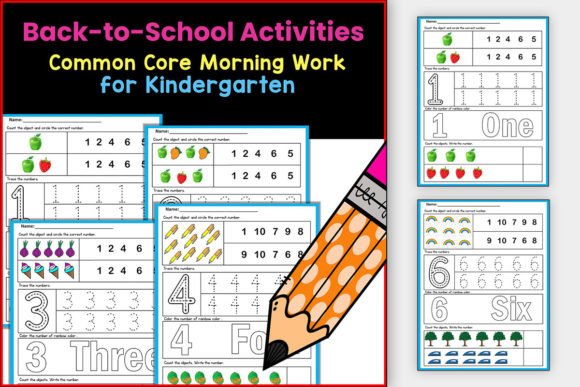
Back to School Morning Work for Kindergarten: A Practical, Print-Ready Resource for Early Learners
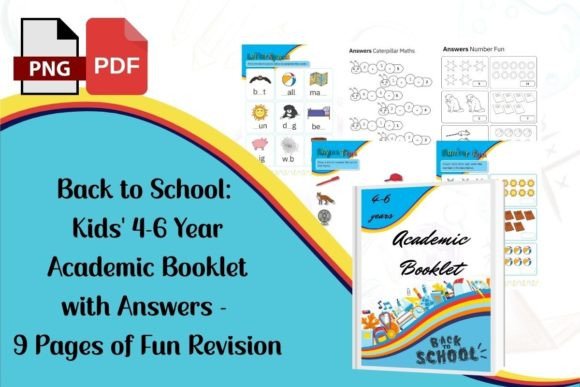
Back to School Morning Work for Kindergarten is a purpose-built collection of 27 ready-to-use activities designed specifically for the first weeks of kindergarten. Unlike generic worksheets or broad curriculum supplements, this packet focuses on repetition, clarity, and developmentally appropriate scaffolding—key elements for building independence in five- and six-year-olds. Each page supports foundational math and literacy skills while minimizing teacher prep time and maximizing student engagement during those critical morning routines.
What Sets This Back to School Morning Work for Kindergarten Apart
The distinction lies not just in content—but in execution. At 8.5 × 11 inches, every page fits standard classroom printers without scaling or cropping. The package includes 27 pages in three formats: print-ready PDF (with no bleed), high-resolution PNG, and JPG files—giving educators flexibility across devices and printing environments. There’s no need to convert, resize, or troubleshoot layout issues. What you download is what you print—and what students use.
This isn’t a digital-only tool requiring tablets or logins. It’s tactile, screen-free, and intentionally low-tech—aligning with research that shows young children benefit most from hands-on, paper-based practice when developing fine motor control and early academic habits. The activities are deliberately simple: tracing numbers, matching uppercase and lowercase letters, counting objects, identifying basic shapes, and coloring by letter or number. Simplicity here is strategic—not a limitation.
How It Compares With Other Morning Work Options
Many teachers consider alternatives like editable Google Slides decks, subscription-based worksheet libraries, or teacher-made bundles shared on community platforms. Each has tradeoffs. Editable digital resources offer customization but require tech access, device management, and often extra formatting before printing. Subscription services may include hundreds of pages—but sorting through them for age-appropriate, standards-aligned, *print-optimized* material takes time—time most kindergarten teachers don’t have in August.
In contrast, Back to School Morning Work for Kindergarten delivers focused utility: 27 pages, all aligned to Common Core standards for kindergarten (K.CC.A.3, K.L.1.E, K.G.A.2, among others), with consistent visual structure and predictable routines. Students learn quickly how each page works—reducing questions and increasing stamina. That predictability supports executive function development, especially for learners who thrive on routine or need extra processing time.
Compared to full-year morning work sets, this packet is intentionally limited in scope. It doesn’t try to cover every skill for the entire school year. Instead, it targets the *first 3–4 weeks*: the window when students are learning classroom procedures, building stamina for seated tasks, and internalizing expectations. That narrow focus makes it more usable—not less.
Strengths and Realistic Tradeoffs
Strengths:
- Consistent formatting—same layout across all 27 pages reduces cognitive load for emerging readers and writers.
- No setup required—no cutting, laminating, or assembling; just print and go.
- Multiple file formats—PNG and JPG allow for easy integration into digital learning platforms (e.g., uploading to Seesaw as static images), while the PDF ensures fidelity for bulk printing.
- Standards-aligned without being rigid—activities support standards like “Write numbers from 0 to 20” or “Recognize and name all upper- and lowercase letters,” but do so through accessible, low-pressure tasks.
Tradeoffs to consider:
- This is not a differentiated resource—it offers one level of challenge per activity. Teachers supporting diverse learners may need to add verbal scaffolds, manipulatives, or extension prompts.
- It does not include answer keys or teaching notes—by design. The expectation is that kindergarten staff will use these as independent practice, not assessment tools.
- There are no thematic variations (e.g., fall, winter, space) built in. If your classroom relies heavily on seasonal hooks to sustain interest, you’ll want to supplement later in the year.
When This Back to School Morning Work for Kindergarten Fits Best
This resource shines in settings where consistency, accessibility, and immediacy matter most. Think: classrooms with mixed literacy exposure (some students entering with alphabet knowledge, others with none), schools limiting screen time in early grades, or districts where teachers receive minimal curriculum guidance for the first month.
It’s also well-suited for interventionists or paraprofessionals supporting small groups—they can pull individual pages based on observed needs (e.g., extra letter-matching practice for a child confusing “b” and “d”) without needing to navigate a larger system.
One practical example: A teacher in a dual-language program uses the letter-tracing pages alongside oral vocabulary practice in both English and Spanish. Because the visuals are clean and uncluttered, students focus on formation—not decoding busy graphics. Another educator prints the counting pages double-sided and staples them into a “First Week Journal,” giving students a tangible sense of progress.
When You Might Choose Something Else
If your priority is real-time data collection—for instance, tracking mastery of specific phonics patterns or number sense benchmarks—you’ll likely pair this with quick observational checklists or brief exit tickets. Back to School Morning Work for Kindergarten is formative, not summative.
Similarly, if your school emphasizes project-based learning or play-based centers from day one, this packet may feel too structured. Some educators prefer open-ended morning invitations—like “draw something that starts with /m/” or “build a tower with 5 blocks”—that invite creativity over replication. Neither approach is superior; they serve different pedagogical goals.
And if you’re looking for long-term planning support—spiral review calendars, editable lesson notes, or scope-and-sequence maps—this isn’t that tool. It’s a targeted launchpad, not a full-year roadmap.
Making an Informed Choice
Evaluating Back to School Morning Work for Kindergarten isn’t about finding the “best” resource—it’s about matching the right tool to your current context. Ask yourself:
- Do my students need predictable, low-frustration tasks to build stamina during morning arrival?
- Is print accessibility non-negotiable? (e.g., limited device access, unreliable internet, district policies restricting screen time.)
- Do I value having a complete set of materials ready before Day 1—without needing to curate, edit, or test compatibility?
- Am I comfortable adapting or extending activities based on student response—or do I need built-in differentiation?
If the first three resonate strongly, this packet aligns well. If the fourth is essential, consider using it as a core component within a broader toolkit—adding sentence frames for ELL learners, number lines for struggling counters, or tracing overlays for students still developing pencil control.
Ultimately, Back to School Morning Work for Kindergarten serves a clear, narrow purpose: helping kindergartners begin the year with confidence, consistency, and quiet momentum—while giving adults space to greet families, manage logistics, and observe emerging strengths. That balance—between student agency and teacher capacity—is what makes it worth considering among the many options available.