Back to School Pencil Alphabet Doodle: A Practical Design Asset for Educators and Creators
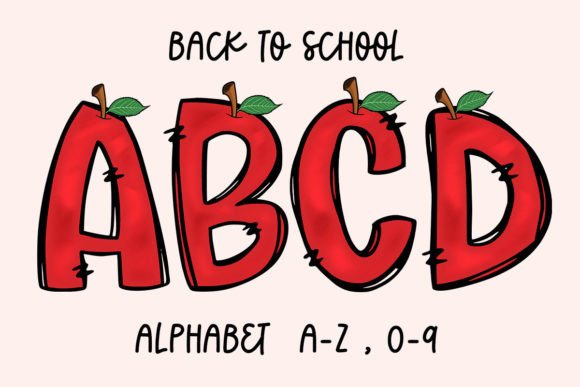
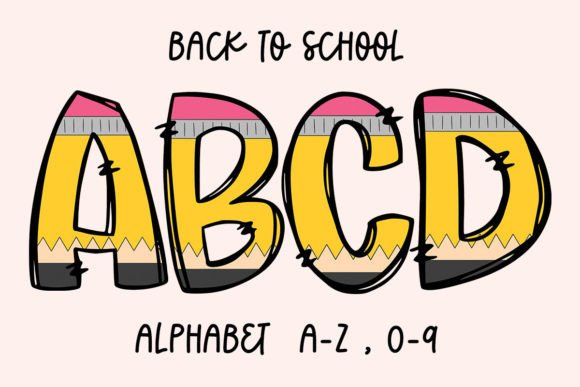
The Back to School Pencil Alphabet Doodle is a cohesive, ready-to-use digital alphabet set designed with both function and aesthetic consistency in mind. Unlike generic clipart or hand-drawn fonts that vary in weight, scale, or style, this collection features 26 uppercase letters (A–Z) and numerals — all rendered as clean, hand-sketched pencil doodles inside subtle pencil-shaped outlines. It’s not a font file or vector-based SVG; it’s a set of high-resolution PNGs with transparent backgrounds, delivered at 300 DPI for professional-grade printing and sublimation workflows.
What Sets This Alphabet Apart From Other Educational Clipart?
Most school-themed design assets fall into one of two categories: overly playful cartoon sets that lack versatility, or sterile, minimalist fonts that feel disconnected from the tactile, analog warmth of back-to-school season. The Back to School Pencil Alphabet Doodle bridges that gap. Each letter retains the organic imperfection of pencil sketching — slight line variation, soft shading, and gentle tapering — while maintaining consistent proportions, baseline alignment, and visual weight across the full set. That uniformity matters: it means you can mix letters freely on a banner, classroom poster, or mug without noticeable inconsistencies in scale or stroke density.
This isn’t just stylistic cohesion — it’s functional reliability. Because every file is pre-rendered as a finished PNG (not layered PSDs or editable vectors), there’s no risk of missing fonts, broken layers, or inconsistent rendering across platforms. You open the file, place it in your layout, and it works — whether you’re using Canva, Adobe Photoshop, Affinity Designer, or even basic Windows Paint for quick edits.
Real-World Use Cases and Workflow Integration
For educators preparing classroom materials, the Back to School Pencil Alphabet Doodle delivers immediate utility. Think: personalized name tags for desks, themed bulletin board headers (“Welcome Back, [Student Name]!”), or printable flashcards where each letter appears alongside its corresponding pencil icon. Since each PNG has a transparent background, overlaying text or photos behind the letters is straightforward — no clipping masks or layer adjustments required.
Small business owners and crafters using sublimation benefit from the 300 DPI resolution and clean edges. These files hold up well when printed onto sublimation paper and transferred onto ceramic mugs, tumblers, tote bags, or coasters — especially at common sizes like 3"–5" tall. We tested several letters printed at 4" height on white ceramic mugs: no visible pixelation, no haloing around edges, and accurate grayscale reproduction of the pencil texture. That fidelity translates directly to perceived product quality for customers.
Bloggers and content creators also find value here. A teacher running an education-focused website might use individual letters to illustrate blog post sections (“P is for Phonics”, “R is for Reading Logs”) — the pencil motif reinforces theme without overwhelming the layout. Similarly, freelance designers building welcome kits for new hires at edtech startups have used this set to create branded onboarding printables that feel approachable yet polished.
Strengths in Practice: Quality, Flexibility, and Consistency
- Quality: At 300 DPI and with anti-aliased edges, these PNGs retain clarity even when scaled up to ~8" in print — ideal for framed art prints or large-format classroom displays.
- Flexibility: While not editable (no vector paths or layered source files), the transparency and resolution make them adaptable across mediums: digital newsletters, social media graphics, Cricut overlays (when imported as PNG), and printed stationery.
- Consistency: All letters share identical stroke width, spacing rhythm, and pencil-texture density. That predictability reduces time spent manually adjusting alignment or contrast between characters — a tangible efficiency gain for batch projects like alphabet posters or student work folders.
Who Benefits Most — and When It Might Fall Short
The Back to School Pencil Alphabet Doodle serves professionals who prioritize speed, thematic relevance, and print-ready output over deep customization. Teachers preparing first-week materials, small-batch sublimation sellers launching seasonal inventory, marketing coordinators designing back-to-school email campaigns, and curriculum designers building printable resources will find this set immediately useful.
It’s less suited for users needing fine-grained control — such as adjusting individual line thickness, recoloring strokes non-destructively, or converting letters to cut files for vinyl or laser cutting. Since these are flattened PNGs (not SVG or EPS), those tasks require external editing tools and introduce potential quality loss. Likewise, if your project demands lowercase letters, ligatures, or multilingual diacritics, this set won’t accommodate those needs — it’s strictly uppercase A–Z and numerals.
Also worth noting: because the pencil outline is part of each letter’s composition (not a separate graphic element), you cannot isolate the doodle from its container shape without manual masking. That limits flexibility in layouts requiring floating letters without borders — though many users find the pencil frame adds charm rather than constraint, especially in educational contexts.
Practical Recommendations for Getting the Most From This Set
Start by auditing your current design toolkit. If you rely heavily on free clipart with mismatched styles or default system fonts that lack thematic resonance, integrating the Back to School Pencil Alphabet Doodle can elevate consistency across multiple touchpoints — from physical classroom decor to digital announcements.
For sublimation users: test one letter at your intended size and substrate before committing to a full run. Adjust brightness/contrast slightly in your RIP software if needed — the pencil grayscale tends to reproduce best with minimal color profile interference.
Educators building reusable resources should consider saving versions of key letters (like A, S, T, and B for “Back to School”) as labeled templates in Google Slides or PowerPoint. That way, swapping names or themes takes seconds — not minutes.
Finally, pair this set intentionally. Its warm, analog tone pairs well with muted kraft paper textures, soft watercolor backgrounds, or clean sans-serif body text. Avoid competing decorative fonts or high-contrast neon elements unless deliberately aiming for ironic contrast — the strength of this alphabet lies in its quiet, grounded authenticity.
In summary, the Back to School Pencil Alphabet Doodle isn’t a flashy tool — it’s a quietly effective one. It solves real workflow problems: reducing visual mismatch in themed projects, accelerating production of classroom-ready assets, and supporting scalable sublimation output without technical friction. For professionals who value coherence, clarity, and context-appropriate design — not just novelty — it earns its place in the resource library.